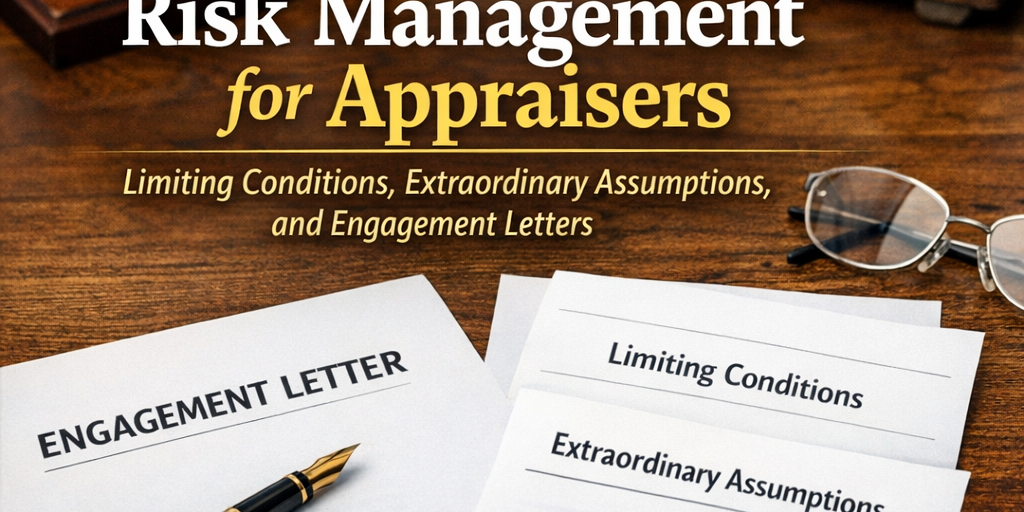
Every appraisal assignment carries risk—legal, professional, and financial. For personal property appraisers, that risk often stems not from valuation methodology, but from unclear scope, misaligned client expectations, or misunderstood report limitations.
Three of the most powerful and underutilized tools appraisers have to manage risk are:
- Limiting Conditions
- Extraordinary Assumptions
- Engagement Letters
Used correctly and consistently, these tools do more than protect the appraiser—they create transparency, credibility, and professionalism.
Limiting Conditions: Defining the Boundaries of Your Work
Limiting conditions clarify what the appraisal does not cover. They communicate constraints under which the assignment was completed and set reasonable boundaries for reliance on the report.
Common limiting conditions in personal property appraisal include:
- No obligation to authenticate items unless explicitly stated
- No responsibility for hidden defects or conditions not observable
- Reliance on client-provided information without independent verification
- No legal opinions regarding ownership or title
Limiting conditions do not weaken an appraisal. When clearly articulated, they strengthen defensibility by documenting the real-world limitations faced by the appraiser during the assignment.
Risk tip: Avoid boilerplate language that isn’t relevant. Courts and reviewers are far more receptive to limiting conditions that clearly tie to the specific assignment.
Extraordinary Assumptions: Necessary, But Dangerous if Misused
An extraordinary assumption assumes a fact that may not be true, but is necessary to proceed with credible results. Under USPAP, extraordinary assumptions must be:
- Explicitly stated
- Reasonable
- Clearly labeled
- Integral to the assignment results
Examples might include:
- Assuming an item is authentic pending expert confirmation
- Assuming restoration quality when condition cannot be fully verified
- Assuming completeness of a collection not physically inspected
The danger arises when extraordinary assumptions are implied rather than disclosed. Reviewers, attorneys, and insurers consistently flag reports where assumptions are buried or unclear.
Best practice: Include a brief explanation of why the extraordinary assumption was necessary and how results could change if it proves false.
Engagement Letters: Your First Line of Defense
Risk management begins before the appraisal starts. A strong engagement letter sets expectations, defines the scope of work, and prevents misunderstandings that later become disputes.
An effective engagement letter should clearly identify:
- Intended use and intended users
- Type of value and effective date
- Scope of research and inspection
- Fee structure and payment terms
- Assumptions and limiting conditions
- Report type to be delivered
For personal property appraisers, engagement letters are especially important when working with:
- Estates and attorneys
- Divorce or equitable distribution matters
- Insurance scheduling or claims
- Partial inspections or remote research
Key insight: A signed engagement letter doesn’t just protect you legally—it improves client confidence and reduces revision requests later.
How These Tools Work Together
Limiting conditions, extraordinary assumptions, and engagement letters are most effective when they reinforce each other:
- Engagement letters define the agreement
- Extraordinary assumptions disclose what is assumed
- Limiting conditions explain what falls outside the assignment
Together, they create a clear narrative that demonstrates professional judgment, compliance, and transparency.
Final Thoughts: Professionalism Is Preventive
Risk management in appraisal is proactive, not reactive. Appraisers who consistently document scope, limitations, and assumptions experience:
- Fewer disputes
- Fewer unpaid invoices
- Stronger E&O insurance positioning
- Better outcomes during reviews or litigation
In many cases, a well-written engagement letter and clear disclosures are more valuable than the most detailed valuation grid.
A Minority Woman-Owned Business with Global Reach
Headquartered in Lucas, Texas, Collectorpro Software Inc is a minority woman-owned business that serves clients across the United States and internationally. Their commitment to customer support, training, and continuous improvement has earned them a loyal user base and a respected reputation in the appraisal industry.
Find out more at the Collectorpro Website